
Sub-Total: $0.00

Most warehouses don’t run out of space all at once. They lose it to aisles sized for forklift access, and to selective pallet rack layouts where every pallet is reachable but much of the floor is aisle. Denser systems fix this by trading some access for more pallet positions. The real question is which trade fits your inventory and your budget.
Pallet flow, push-back, and drive-in are the three systems most often compared. Each stores pallets in deep lanes, but they differ in how pallets move, how they’re rotated, and what they cost per position.
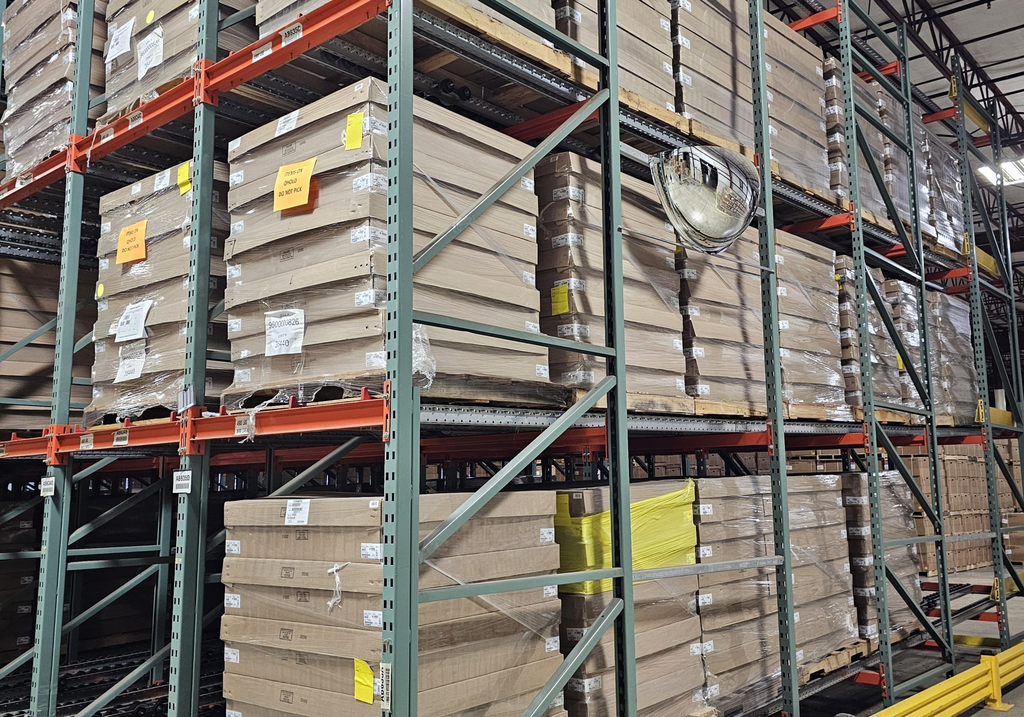
Where Selective Pallet Rack Falls Short
Selective pallet rack gives you direct access to every pallet, which is why it’s the default for many operations. The cost is density. One aisle serves one or two rows of rack, so a large share of the floor is aisle space. If you carry a high pallet count per SKU, or you’re near capacity, the aisles become the most expensive part of the building.
How the Three Systems Compare
| Feature | Pallet Flow | Push-Back | Drive-In |
| Rotation | FIFO (first-in, first-out) | LIFO (last-in, first-out) | LIFO (last-in, first-out) |
| How pallets move | Gravity-fed rollers or wheel tracks on an incline | Pallets sit on nested carts that ride inclined rails | Forklift drives into the lane and sets pallets on rails |
| Access | Separate loading and picking aisles | One aisle for loading and picking | One aisle, with the forklift entering the lane |
| Best for | Date-coded or high-turnover SKUs with deep stock | Moderate SKU counts with several pallets per SKU | Non-perishable bulk storage with few SKUs |
| Forklift in the lane? | No | No | Yes |
| Relative cost per position | Higher | Moderate | Lower |
| Density | High, but needs two aisles | High, with a single aisle | Highest, with a single aisle |
What the Trade-Offs Mean in Practice
Pallet flow is the only one of the three that gives you FIFO rotation in a deep lane. Pallets are loaded at the high end and roll to the pick face, so the oldest stock is always the next pallet out. The catch is that it needs a loading aisle and a picking aisle, which offsets some of the density gain. Components, roller and wheel options, lane depths, and capacities are covered on our pallet flow rack page.
Push-back keeps everything in one aisle, which saves floor space and simplifies traffic. Pallets are loaded and picked from the same side, so rotation is LIFO. It suits operations where several pallets of the same SKU can sit in a lane and stock age doesn’t matter much.
Drive-in can provide the highest storage density of the three and can have a lower cost per position than pallet flow. The forklift drives into the lane, which slows handling and raises the risk of rack damage. Rotation is LIFO, so it works best for non-perishable bulk stock with few SKUs.
Compared with drive-in, pallet flow and push-back both keep the forklift out of the storage lane. That means fewer trips into the rack, less product handling, and less rack damage.
Is Pallet Flow Worth the Cost?
Pallet flow is one of the more expensive systems per pallet position. The lanes include rollers or wheel tracks, speed controllers, and separators, all engineered to move loaded pallets reliably. On a cost-per-position basis, drive-in and push-back will often be less expensive than pallet flow.
The better comparison is total value. Pallet flow tends to pay off when:
- Rotation matters, and mistakes mean spoilage, write-offs, or expired product.
- Throughput is high, and pick speed and forklift travel time have a real labor cost.
- Floor space is expensive enough that adding storage density is cheaper than expanding the building.
If none of those apply, a lower-cost system is usually the smarter buy.
What Actually Jams a Pallet Flow Lane
The most common cause of jams is the pallets themselves. Lanes are engineered around a consistent pallet, and problems usually start with:
- Pallet condition: broken or missing deck boards, protruding nails, and warped or damaged runners can catch on rollers or wheels.
- Pallet type: flow lanes generally need solid, closed-bottom pallets in good condition. Mixing pallet types or sizes in a lane causes hang-ups.
- Orientation: pallets must be loaded in the direction the lane was designed for. A pallet placed the wrong way can stall or skew mid-lane.
- Load quality: overhanging or unstable loads can shift as they roll.
If your pallet pool is inconsistent, plan for stricter pallet inspection, or reconsider pallet flow altogether. Confirm specific pallet requirements with the manufacturer before ordering.
Speed Controllers and Pallet Separators
Gravity does the work, so the lane needs to control it. Speed controllers (brakes) keep loaded pallets from accelerating down the incline and hitting the end of the lane hard. Pallet separators at the exit end hold back the second pallet so the front pallet can be removed safely, without the next one pressing against it. Both are part of a proper lane design, not optional extras, so factor them into cost comparisons.
When Pallet Flow Is Not a Good Fit
Pallet flow is not the right answer for every operation. It’s usually a poor fit when:
- You have many SKUs with only one or two pallets each. Lanes work best with enough stock of one SKU to fill them.
- Turnover is slow, and FIFO rotation isn’t a business requirement.
- Pallet quality is inconsistent and you can’t standardize it.
- Loads are unstable, irregular, or too light to roll reliably. Confirm minimum and maximum pallet weights with the manufacturer.
- Your budget can’t support a higher cost per position, and rotation isn’t critical.
- The layout can’t accommodate separate loading and picking aisles.
In these cases, selective pallet rack, push-back, or drive-in will usually serve you better.
Quick Decision Guide
- Choose pallet flow if you need FIFO rotation, move stock quickly, and can support two aisles and a higher upfront cost.
- Choose push-back if you want density with a single aisle and rotation isn’t critical.
- Choose drive-in if you store large quantities of a few non-perishable SKUs and cost per position matters most.
- Stay with selective pallet rack if you carry many SKUs with low pallet counts and need direct access to every pallet.
Frequently Asked Questions
Do I still need aisles with pallet flow?
Yes. Pallet flow needs a loading aisle and a picking aisle. The gain comes from deep lanes and continuous replenishment, not from eliminating aisles.
Is pallet flow more expensive than push-back?
Usually, yes. Pallet flow typically costs more per position because of the lane components and controls. Push-back has a lower cost, but it gives LIFO rotation and shares one aisle for loading and picking.
Can I store more than one SKU per lane?
It’s generally best to dedicate each lane to one SKU or lot. Mixing products defeats the FIFO benefit and can complicate picking.
Which system is best if I have a lot of SKUs?
Selective pallet rack is usually the better fit for high SKU counts with few pallets per SKU. Deep-lane systems work best when you have enough volume per SKU to fill the lanes.
Choosing the Right System
The best system depends on your rotation needs, SKU mix, pallet quality, and budget. If pallet flow looks like a fit, review the specifications on our pallet flow rack page. B & C Industrial Products can also help you compare all three options against your current SKUs and throughput. Contact a storage specialist to talk through layout and configuration.
Related Post

When Phenolic Caster Wheels Outperform Polyurethane and When They Don’t
Choosing a caster wheel isn’t simply about finding the toughest option. The right wheel depends on what the equipment carries,…

The Equipment Behind the American Workforce
Automation is changing warehouse work. It is not making the people doing it any less essential. This Labor Day, it…

Why Kingpinless Swivel Casters Last Longer in High-Impact Industrial Applications
Anyone who’s run a warehouse floor for more than a few months has a caster horror story. A wheel starts…

Six Material-Handling Fixes Worth Making Before Q4 Volume Hits
Demand is building from more than one direction this year. Steel Dynamics reported its fabrication backlog running nearly 45% higher…

The Hidden Productivity Cost of Using the Wrong Lift Table in Material Handling Operations
Walk into almost any warehouse, distribution centre, or production line and you’ll spot a scissor lift table quietly doing its…

Single-Sided vs. Double-Sided Cantilever Racks: Which Configuration Actually Fits Your Warehouse
Most warehouses don’t run into trouble because of a bad rack. They run into trouble because someone picked the wrong…

Why Material Flow Will Define the Next Generation of American Manufacturing
American manufacturing is gaining momentum as more companies invest in domestic production and modernize their operations. While automation, robotics, and…

Ceiling-Mounted Bridge Cranes vs. Gantry Cranes: Choosing the Right Lifting Solution
If you’ve been tasked with improving material flow in your facility, chances are you’ve already searched “bridge crane vs gantry…

A Warehouse Mezzanine Might Be the Best Investment You Haven’t Made Yet
If you’ve ever walked through your warehouse and thought, “We’re running out of room but moving to a bigger facility…

National Safety Month: What Warehouse Operations Get Wrong About the Equipment Right in Front of Them
June is National Safety Month, and across warehouses, distribution centres, and manufacturing facilities throughout the United States, safety will once…