
Sub-Total: $0.00

Table of Contents
Walk into almost any warehouse, distribution centre, or production line and you’ll spot a scissor lift table quietly doing its job raising a pallet to waist height, positioning a load for an operator, or feeding a conveyor line. They’re so common that most facility managers stop thinking about them once they’re installed. That’s exactly the problem.
The wrong lift tables don’t fail loudly. They don’t break down on day one. Instead, they quietly drain productivity for months through slower cycle times, awkward operator posture, unplanned maintenance, and bottlenecks that never show up as a single line item on a P&L. By the time the cost is visible, it’s already baked into your operation.
Why “Any Lift Table Will Do” Is a Costly Assumption
Lift tables aren’t a one-size-fits-all category. Capacity ratings, platform size, vertical travel, lift speed, and control type all vary widely, and picking based on price or availability alone can lead to a poor fit for the application.
A few common mismatches we see across manufacturing and distribution operations:
- Undersized capacity — Running a table near the upper end of its rated load limit leaves little margin for real-world variability, which often results in more conservative, slower operation.
- Insufficient vertical travel — If the table can’t reach the height an operator actually needs, workers compensate with bending, reaching, or manual lifting reintroducing the exact ergonomic risk the equipment was meant to eliminate.
- Wrong control type — A hand-control unit on a line where operators need both hands free can slow individual cycles, and that added time adds up across a shift.
- Mismatched platform size — Loads that overhang the platform create instability, slow handling, and safety concerns.
None of these issues are dramatic on their own. But multiplied across hundreds of lift cycles a day, they add up to real, measurable losses.
The Productivity Cost, Broken Down
1. Slower cycle times. An undersized or poorly matched lift table forces operators to work more cautiously, take extra positioning steps, or wait longer for the platform to reach height. Seconds per cycle become hours per week.
2. Increased injury risk and downtime.Musculoskeletal disorders (MSDs) are a leading cause of lost-time workplace injuries. According to the U.S. Bureau of Labor Statistics, private industry employers reported over 500,000 workplace MSD cases involving days away from work in 2021–2022, at an annualized rate of roughly 25 cases per 10,000 full-time workers. A lift table that doesn’t match the task pushes workers back into the repetitive bending and lifting that ergonomic equipment is supposed to eliminate, which shows up later as injury claims and lost labour hours.
3. Higher maintenance frequency. Running equipment outside its rated specifications overloading beyond the rated capacity or exceeding the duty cycle it was built for can shorten service life and increase unplanned downtime for repairs. Control type has more impact on workflow and ergonomics than on equipment longevity, but choosing one that doesn’t match the pace of the line can still add unnecessary steps to every cycle.
4. Workarounds that create new bottlenecks. When a lift table doesn’t fit the task, operators improvise stacking extra pallets, using forklifts for short lifts, or skipping the table altogether. Each workaround adds steps, and steps add time.
What the Right Lift Table Actually Solves
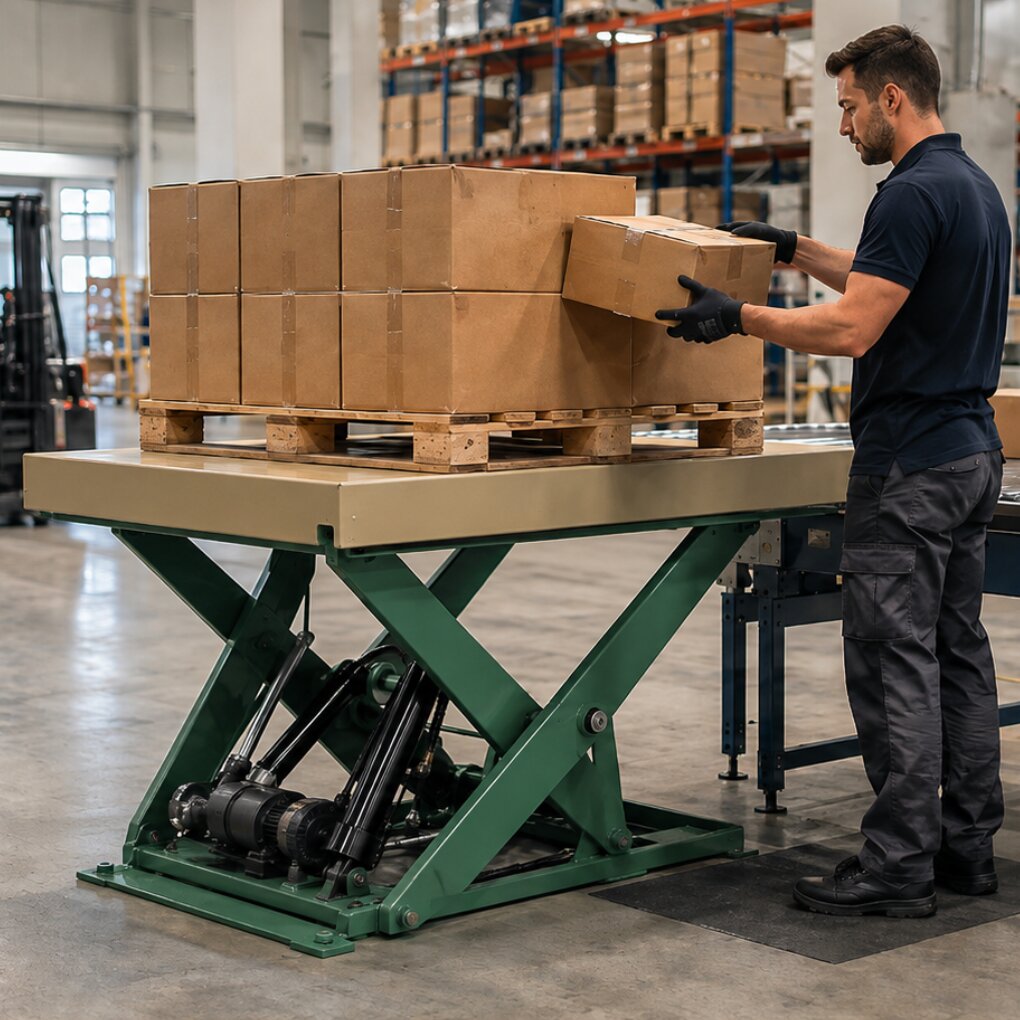
A properly specified hydraulic lift table or scissor lift table does more than move a load up and down. It’s an ergonomic intervention that keeps loads at the correct working height, reduces manual handling, and keeps cycle times consistent shift after shift. Matching capacity, platform dimensions, vertical travel, and control style to the actual task not just the budget line is what determines whether a lift table becomes a productivity asset or a hidden liability.
At B&C Industrial Products, the lift table range spans mobile foot-operated units for light-duty positioning up to heavy-capacity industrial tables rated for thousands of pounds, with multiple platform sizes, vertical travel ranges, and control options (foot switch, hand control, and push-button pendant) to match the actual workflow rather than a generic spec shee.
Choosing the Right Fit
Before selecting a lift table, it helps to map out:
- Load weight and frequency — the true operating capacity needed, with margin, not just peak load
- Working height range — the minimum and maximum height operators actually need to reach
- Platform footprint — sized to the load, not just “close enough”
- Control method — matched to how hands-free (or not) the operator needs to be
- Duty cycle — how many lifts per hour the table will realistically handle
Getting this right at the sourcing stage is far cheaper than absorbing months of slower cycles, higher injury risk, and reactive maintenance later. If you’re evaluating options for your facility, it’s worth comparing rated capacities and vertical travel across models before making a decision a mismatch here isa common, and often avoidable, cause of hidden productivity loss on the floor.
Pairing the right lift table with complementary handling equipment such as pallet jacks for moving loads between stations or casters for mobile workstations often closes the remaining gaps in a material handling workflow, turning isolated equipment upgrades into a genuinely faster, safer line.
Explore the full range of lift tables to find the capacity, platform size, and control type that actually fits your operation, or reach out to a material handling products specialist for help specifying the right unit.
Related Post

Pallet Flow vs. Push-Back vs. Drive-In: Which Storage System Is Worth the Cost?
Most warehouses don’t run out of space all at once. They lose it to aisles sized for forklift access, and…

When Phenolic Caster Wheels Outperform Polyurethane and When They Don’t
Choosing a caster wheel isn’t simply about finding the toughest option. The right wheel depends on what the equipment carries,…

The Equipment Behind the American Workforce
Automation is changing warehouse work. It is not making the people doing it any less essential. This Labor Day, it…

Why Kingpinless Swivel Casters Last Longer in High-Impact Industrial Applications
Anyone who’s run a warehouse floor for more than a few months has a caster horror story. A wheel starts…

Six Material-Handling Fixes Worth Making Before Q4 Volume Hits
Demand is building from more than one direction this year. Steel Dynamics reported its fabrication backlog running nearly 45% higher…

Single-Sided vs. Double-Sided Cantilever Racks: Which Configuration Actually Fits Your Warehouse
Most warehouses don’t run into trouble because of a bad rack. They run into trouble because someone picked the wrong…

Why Material Flow Will Define the Next Generation of American Manufacturing
American manufacturing is gaining momentum as more companies invest in domestic production and modernize their operations. While automation, robotics, and…

Ceiling-Mounted Bridge Cranes vs. Gantry Cranes: Choosing the Right Lifting Solution
If you’ve been tasked with improving material flow in your facility, chances are you’ve already searched “bridge crane vs gantry…

A Warehouse Mezzanine Might Be the Best Investment You Haven’t Made Yet
If you’ve ever walked through your warehouse and thought, “We’re running out of room but moving to a bigger facility…

National Safety Month: What Warehouse Operations Get Wrong About the Equipment Right in Front of Them
June is National Safety Month, and across warehouses, distribution centres, and manufacturing facilities throughout the United States, safety will once…